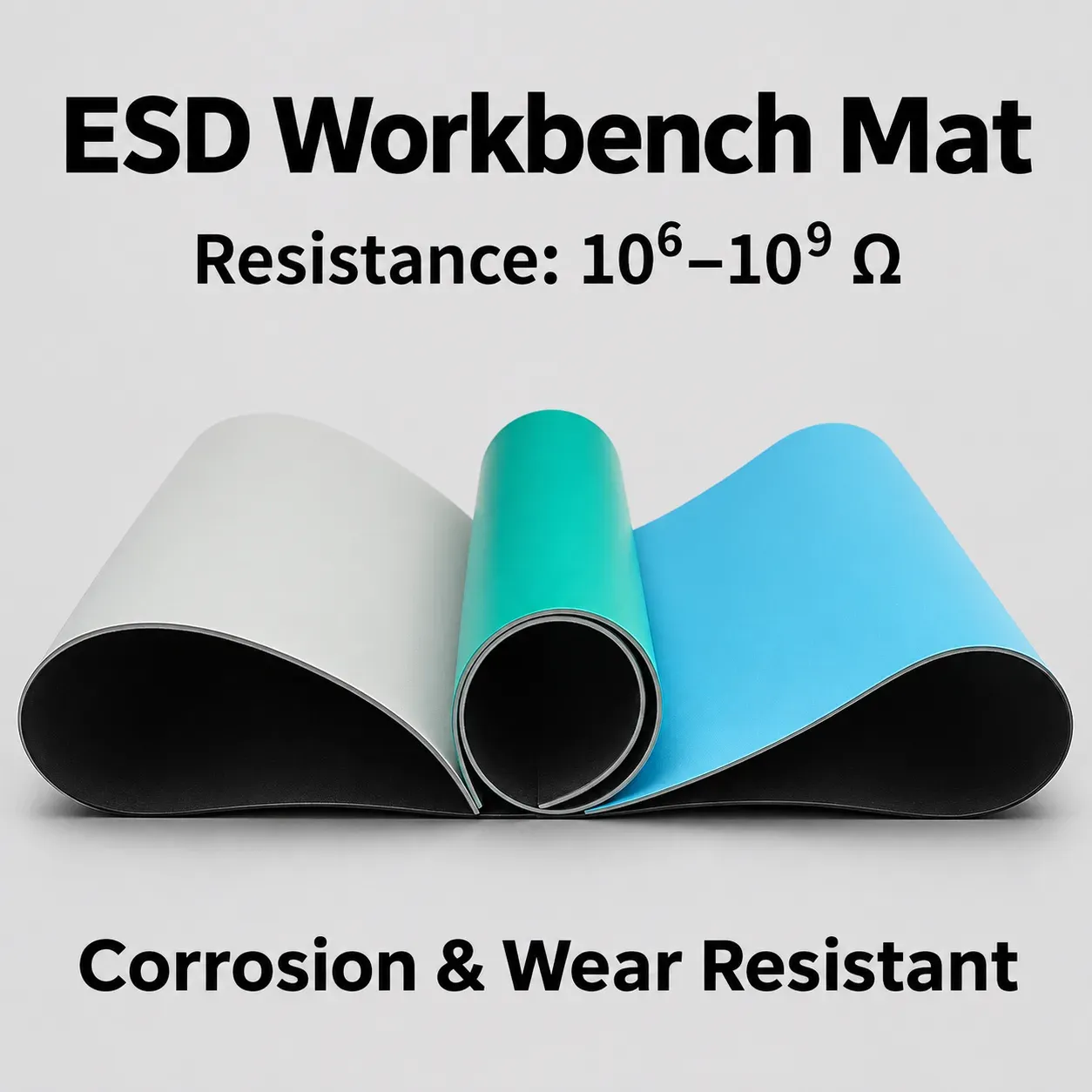
How to Choose an ESD Table Mat for Your Workbench
Choose an ESD table mat by surface resistance (10⁶–10⁹ Ω), material, thickness and grounding. Includes a resistance classification table and checklist.

Choose an ESD table mat by four verifiable specifications: surface resistance, material, thickness and size. Our two-layer mats publish a surface resistance of 10⁶–10⁹ Ω, with 2 mm and 3 mm rubber options and PVC alternatives. This guide adds the classification table and checks the original version omitted.
An ESD table mat should match the electrical requirements, working conditions and dimensions of your workstation. Before ordering, confirm the material, resistance specifications, grounding connection and required size. Colour and thickness alone do not tell you whether a mat is suitable for handling sensitive electronic components.
This guide explains what to compare when selecting an anti-static workbench mat for electronics assembly, inspection, repair or laboratory use — and gives the numbers our product pages already publish, so you can compare quotations against fixed values instead of descriptions.
1. Start with Your Working Conditions
First, identify what happens on the bench. A workstation used for component inspection may have different requirements from one used for soldering, equipment repair or repeated mechanical assembly.
Consider the following questions:
- Will the mat be exposed to solder, heated tools or hot components?
- Which cleaning products, oils or chemicals will contact the surface?
- Will heavy equipment remain on the mat?
- Does the surface need to support precise handling of small components?
- Will the mat be used on one bench or across several production stations?
Share these details with your supplier before choosing a material. A product described simply as an "anti-static mat" may not meet every workstation requirement.
Our stated application range: assembly, repair and laboratory benches. If your bench falls outside this range, state the application in your enquiry so the material can be checked against it.
2. Compare Rubber and PVC Materials
Rubber and PVC, also called vinyl, are common materials used for ESD workbench mats. Their performance depends on the formulation and construction of the specific product.
Both material families in our range use a two-layer construction: a static-dissipative working surface over a conductive black backing layer. The working surface is the side that faces up and contacts components; the black backing is the underside. Standard colours are green, blue, gray and black.
Rubber mats are often selected for electronics workstations where heat and chemical exposure are important considerations. PVC options may suit general assembly, inspection and other applications where the specified product meets the working conditions.
Do not assume that every rubber mat is suitable for soldering, or that every PVC mat has the same properties. Ask for the temperature limits, cleaning guidance and chemical compatibility of the exact model you intend to buy.
For heat exposure, confirm both the temperature and the contact duration. A brief contact rating does not mean the surface can withstand continuous exposure at the same temperature.
3. Check the Electrical Specifications — Now With the Numbers
"Anti-static," "conductive" and "static dissipative" should not be treated as interchangeable product specifications. They describe different resistance ranges:
| Classification | Surface resistance range | What it means at a workstation |
|---|---|---|
| Conductive | Below 1 × 10⁴ Ω | Charge moves very quickly; used where rapid discharge is intended, not as a general worksurface class. |
| Static dissipative | 1 × 10⁴ Ω to below 1 × 10¹¹ Ω | Charge drains at a controlled rate. ESD work surfaces sit in this class; industry references such as ANSI/ESD S20.20 set the worksurface resistance limit below 1 × 10⁹ Ω, and 1 × 10⁶ Ω is the lower bound commonly applied in practice. |
| Insulative | 1 × 10¹¹ Ω and above | Charge is not drained; the material does not provide an ESD discharge path and is not an ESD work surface. |
Our ESD table mats and sheet rolls publish a surface resistance of 10⁶–10⁹ Ω (see MS-E023 and MS-E021) — inside the static-dissipative class and inside the worksurface limit above.
Two different measurements describe a mat's electrical behaviour, and a quotation should say which one is specified:
- Point-to-point resistance — between two points on the working surface.
- Resistance to ground — from the working surface through the grounding connection to the ground point.
Before comparing quotations, confirm:
- Which resistance measurement is specified
- The required resistance range
- The measurement method and test conditions
- Which side of the mat is the working surface
- Whether the specification applies to the supplied finished product
Use the requirements of your ESD control plan as the acceptance criteria. A lower resistance value is not automatically a better choice for every application. For how to read test results, see ESD mat resistance testing: what the numbers mean.
Published: working-surface resistance 10⁶–10⁹ Ω across the mat and roll range.
4. Choose Thickness for the Task
Thickness affects how a mat fits the bench and interacts with equipment. It does not, by itself, establish ESD performance or heat resistance — the resistance range in Section 3 is the same across the thicknesses below.
Published thickness options in our range:
- 2 mm — the standard bench thickness in the two-layer PVC range and the lighter option of the MS-E023 rubber mat.
- 3 mm — the heavier option of MS-E023 (2 mm or 3 mm, blue and teal green), for benches where more material under the work is preferred.
- 1–10 mm as sheet rolls — MS-E021 rubber sheet rolls for benches and floors, cut to size.
Compare the proposed thickness with the weight of the equipment, the need for a firm working surface and any height restrictions around fixtures or bench edges. For a fuller breakdown, see the ESD mat thickness guide.
For repeat orders, specify the nominal thickness and acceptable tolerance. If precise assembly work is involved, evaluate a sample under normal working conditions before placing a larger order.
5. Select Rolls, Sheets or Finished Mats
The most practical supply format depends on your installation.
Finished mats can simplify installation on individual benches. Sheets may suit defined work areas or replacement panels. Roll material can be useful when covering several benches or cutting multiple sizes. As a reference format, MS-E021 rolls are 10 m long in 1 m or 1.2 m widths (green and black), with a cut-to-size service.
Measure the usable work surface before ordering. Include any areas occupied by equipment, raised edges, cable openings or mounting fixtures. See also ESD mat rolls vs pre-cut mats.
For custom-cut ESD mats, provide a drawing showing:
- Overall length and width
- Thickness
- Corner shape or radius
- Hole diameters and positions
- Cutout dimensions
- Dimensional tolerances
Ask the supplier to confirm whether grounding connectors are fitted before or after cutting, and whether accessories are included in the quotation. The ordering steps are set out in how to order custom-cut ESD mats.
6. Plan the Grounding Connection
An ESD mat is one element of a workstation's static-control system. It should be installed with an appropriate connection to the workstation's designated grounding arrangement. We offer custom cutting and grounding snap installation positioned to your requirements, so the snap location can be fixed on the drawing before production rather than after delivery.
Confirm the connector type, grounding cord and compatibility with your existing equipment. Personnel grounding must also be addressed as part of the workstation setup; placing a mat on a table does not replace that requirement. Installation steps are covered in how to ground an ESD mat.
An ESD mat is not a substitute for an electrical insulating safety mat. Applications involving exposed live electrical equipment require a separate safety assessment. The distinction is explained in ESD mats and insulating mats: key differences.
7. Evaluate a Sample Before a Larger Order
Use a sample to assess the product on your actual bench. Sample evaluation and small-batch orders are supported, so a trial quantity can be checked before a production order.
Check whether it lies flat, supports the intended work, fits around equipment and can be cleaned using the recommended method. Assess its electrical performance using your organization's acceptance procedure — for a worksurface, that means checking the measured resistance against the 10⁶–10⁹ Ω range in Section 3.
For custom shapes, approve the dimensions and connector locations before production. Keep the approved sample and agreed specifications as a reference for future orders.
Frequently Asked Questions
What surface resistance should an ESD table mat have?
An ESD work surface should be static dissipative and, per the commonly referenced worksurface limit, below 1 × 10⁹ Ω, with 1 × 10⁶ Ω as the practical lower bound. Our mats and rolls publish 10⁶–10⁹ Ω, which sits inside that window. Confirm which measurement — point-to-point or resistance to ground — a quotation specifies.
Is a thicker ESD table mat always better?
No. Thickness should suit the working surface, equipment and installation. Electrical performance, material suitability and grounding must be assessed separately. Our range covers 2 mm and 3 mm bench mats and 1–10 mm sheet rolls, all publishing the same 10⁶–10⁹ Ω surface resistance.
Can an ESD mat be cut to fit a workbench?
Yes. Mats can be supplied in custom dimensions or cut from rolls, and grounding snaps can be positioned to your drawing. Confirm the permitted cutting method, edge requirements and grounding connector placement with the supplier before production.
Can I use an ESD table mat for soldering?
Only when the specific product is suitable for the expected heat exposure. Confirm the model's temperature limit and permitted contact duration before use; a brief-contact rating does not cover continuous exposure at the same temperature.
Does an ESD table mat need grounding?
Yes, for a grounded ESD workstation the mat needs an appropriate grounding connection; an ungrounded mat has no discharge path. Follow the product's installation instructions and your organization's ESD control procedures, and address personnel grounding as part of the same setup.
What to Send with Your Enquiry
To discuss an ESD table mat with Specific Materials, send your bench dimensions, preferred material, thickness, quantity and intended application.
Include any required electrical specifications and grounding accessories. For custom shapes, attach a dimensioned drawing. These details help us assess the requirement and prepare a relevant quotation.